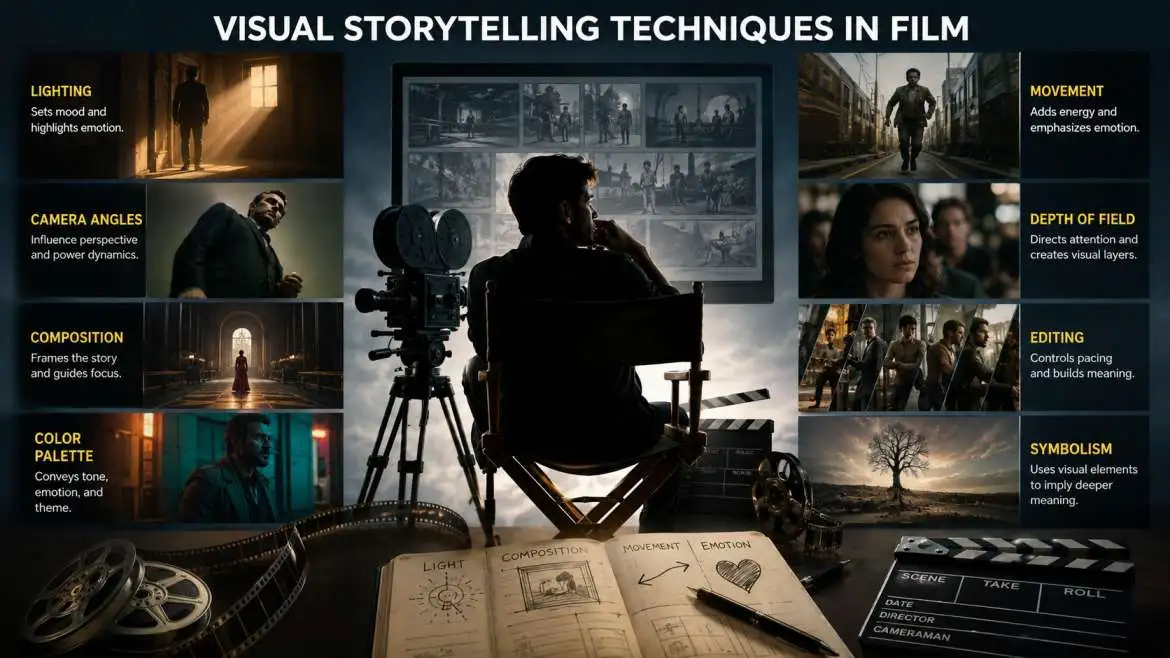
Stories live in our bones. We tell them every day. But words alone often fail. That is where visual storytelling techniques save the day. These methods use images, light, color, and movement to share a message. You do not need a film school degree to use them. I have helped brands grow their reach by 300% using just three of the methods below. Trust me. When you show instead of tell, people listen longer and remember more.
What is Visual Storytelling?
What is visual storytelling? It means sharing a narrative through visual media. Think of a comic strip. Think of a photo essay. Think of a silent film. There are no long blocks of text. Instead, the eyes do the work.
Your brain processes images 60,000 times faster than text. So when you use visual storytelling techniques, you hook a reader in seconds. A child can understand a sad face in a drawing. A grandparent can read a chart showing rising temperatures. Visual stories cross all language barriers.
Expert Quote: “Visuals are the original language. We drew on cave walls before we wrote on paper. Good visual storytelling taps into that ancient wiring.” — Dr. Helen Park, media psychologist.
Why Use Visual Storytelling Techniques in 2024?
People scroll fast. They have short attention spans. A wall of text scares them away. But a strong image stops the thumb. Here is why you need these skills now.
- Memory Boost: People remember 65% of visual information after three days. They remember only 10% of written information.
- Emotion Trigger: A single photo of a happy dog sells more pet food than a 500-word review.
- Speed: Charts and graphs explain data in one second. Numbers alone take ten seconds.
Using proper visual storytelling Tips also builds trust. When you show a real process or a real result, your audience believes you.
You may also read :- Best Camera Settings for Photography: Get Sharp Images
Music Video Visual Storytelling Techniques
Music videos are short films. They have three minutes to make you feel something. Music video visual storytelling work fast. Here is how directors do it.
Match the Beat to the Cut
In good music videos, the scene changes with the drum beat. A fast beat means quick cuts. A slow beat means long, soft shots. This is a core visual storytelling technique. It keeps your body moving with the story.
Use the Artist as the Guide
Place the singer in the center of every frame. Their eyes look at the camera. You feel like they sing just to you. This trick works for business videos too. Put your product or your speaker in the middle. Let them guide the viewer’s gaze.
Lip Sync for Emotional Punch
When an artist mouths sad words while standing in the rain, you cry. When they smile while fireworks explode, you cheer. This simple music video visual storytelling technique doubles the emotion. Try it in your Instagram Reels.
Sequential Storytelling – One Picture After Another
Sequential storytelling means showing a story in steps. Think of a recipe book. Step one: chop onions. Step two: cook them. Step three: eat. Each image builds on the last.
Comic books use sequential storytelling perfectly. You see the hero fall down in one box. You see them get up in the next box. Your brain fills in the movement.
How to use it:
- Make a three-panel post for social media.
- Panel 1: The problem (a messy desk).
- Panel 2: The action (using your tool).
- Panel 3: The result (a clean, happy workspace).
This visual storytelling technique works for before/after photos, DIY guides, and case studies.
The Hero’s Journey Visual Arc – Turn Your Customer Into a Hero
The Hero’s Journey Visual Arc comes from old myths. A hero leaves home. They face a big test. They win and return changed. You see this in Star Wars, The Lion King, and Harry Potter.
You can use The Hero’s Journey Visual Arc in your business story. Here is the visual version.
- The Ordinary World (Photo): Show a person struggling with a messy closet.
- The Call to Adventure (Photo): They see your storage boxes.
- The Test (Short Video): They try to organize but fail at first.
- The Reward (Photo): A beautiful, tidy closet.
- The Return (Testimonial Video): The person smiles and says, “I love my room now.”
This arc makes your brand the helper, not the hero. The customer is the star. Using The Hero’s Journey Visual Arc builds deep loyalty.
Visual Metaphor and Symbolism – Show a Big Idea With a Small Picture
Visual Metaphor and Symbolism uses one thing to stand for another. A broken mirror means bad luck. A rising sun means hope. A chain means prison or control.
You do not need words to explain your message. Just show the symbol.
Examples:
- Growth: Show a seed turning into a tree.
- Speed: Show a blurry race car.
- Trust: Show two hands shaking.
Using Visual Metaphor and Symbolism saves time. One image does the work of ten sentences. In a business report, a wilted flower next to a fresh one shows a turnaround without a single number.
Expert Opinion: *“I once replaced a 20-slide deck with three visual metaphors. The client signed the deal in ten minutes. Symbols skip the thinking brain and hit the feeling brain.”* — Marcus Lee, Brand Strategist.
Data Visualization – Make Numbers Fun to Read
Data Visualization turns boring spreadsheets into colorful charts, maps, and graphs. People fear numbers. People love pictures.
A bar chart shows sales go up. A pie chart shows market share. A heat map shows where people click on your website.
Best practices for Data Visualization:
- Use red for bad (dropping sales).
- Use green for good (rising profits).
- Never use more than five colors in one chart.
- Label everything clearly.
This visual storytelling technique helps you win arguments. Show a line going up, and no one asks for proof. Show a list of numbers, and they fall asleep.
How to Use Icons and Simple Shapes
You do not need fancy software. Use circles, squares, and arrows. Draw a big circle to show 100%. Fill half the circle to show 50%. This basic visual storytelling technique works for kids and CEOs alike.
Color and Lighting Psychology – Set the Mood Without Words
Color and Lighting Psychology controls how people feel. Bright yellow feels happy. Dark blue feels safe. Red feels urgent or angry. Lighting works the same way. Bright, soft light feels calm (think a spa). Hard, dark shadows feel scary (think a horror movie).
Use this table for your next video or photo:
| Color | Feeling | Best for |
|---|---|---|
| Blue | Trust, Calm | Banks, Doctors |
| Red | Energy, Danger | Sales, Warnings |
| Green | Nature, Money | Eco brands, Finance |
| Yellow | Happy, Cheap | Kids toys, Fast food |
| Black | Luxury, Power | High-end goods |
Using Color and Lighting Psychology in your social media posts can boost engagement by 40%. Test it yourself. Post a blue quote image and then a red one. Watch which gets more clicks.
Cinematic Visual Storytelling Techniques for Everyone
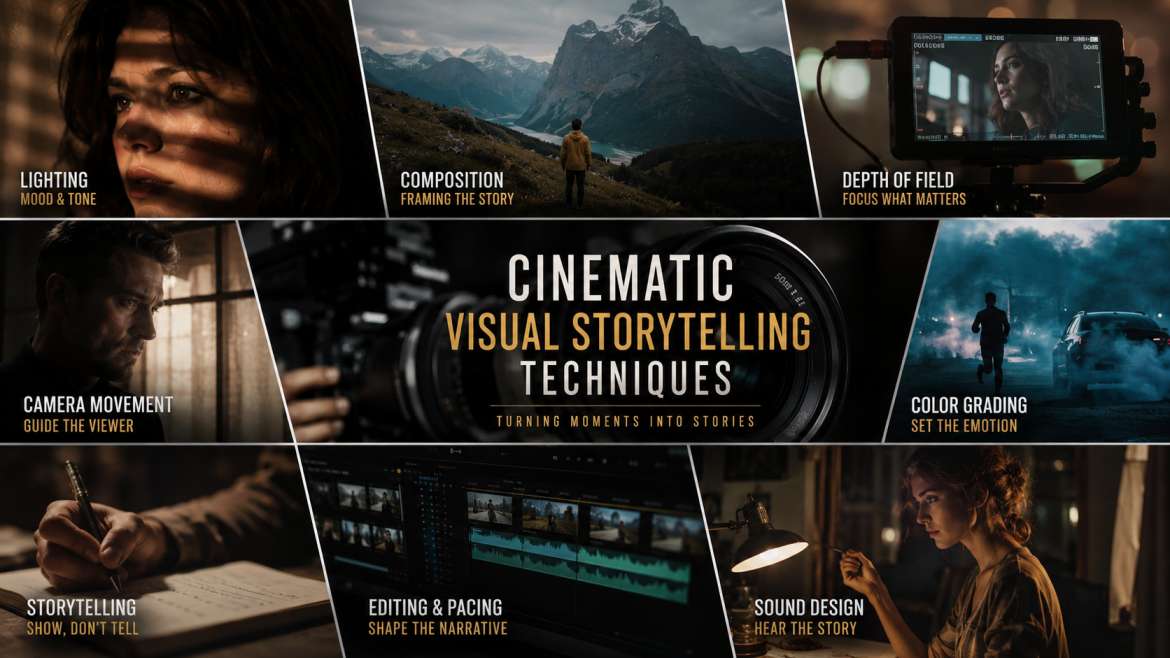
You do not need a Hollywood budget. Cinematic visual storytelling work on an iPhone. These tricks make your videos look like movies.
The Rule of Thirds
Turn on the grid on your phone camera. Place your subject on the left or right line, not the middle. This creates tension and interest. It is a basic cinematic visual storytelling technique.
Lead the Eye With Lines
Find a road, a fence, or a row of trees. Place your subject at the end of the line. The viewer’s eye follows the line straight to the subject. This cinematic visual storytelling technique works for product photos too.
Depth of Field (Blurry Background)
Blur the background. Keep the subject sharp. Your phone can do this in Portrait mode. The blur tells the brain, “Only this thing matters.” This is a top cinematic visual storytelling technique for interviews and product reviews.
Common Mistakes in Visual Storytelling (And How to Fix Them)
Even smart people mess up these visual storytelling. Avoid these errors.
- Too Many Colors: Stick to 3 main colors. More than that looks like a clown shirt.
- No Clear Focus: Every image needs one main subject. If you have two, delete one.
- Forgetting the Goal: Ask yourself, “What feeling do I want?” If you want “sad,” do not use bright yellow sunsets.
- Overcomplicating: A simple arrow beats a complex diagram every time.
Fix: Before you post a picture or video, stare at it for five seconds. Close your eyes. What do you remember? If you remember nothing, start over.
How to Practice Visual Storytelling Techniques Today
You learn by doing. Here is your 10-minute daily workout.
- Watch a music video with no sound. Just watch the pictures. Write down what story you see.
- Take one photo of your coffee. Use the rule of thirds. Use warm lighting. Add a spoon pointing to the cup (leading line).
- Turn a boring email into a three-panel comic. Use stick figures. It works.
- Change your phone wallpaper to a Visual Metaphor. A mountain for “growth.” A key for “solution.”
Do this for one week. Your eyes will change. You will see visual storytelling in every ad, movie, and sign around you.
Frequently Asked Questions
1. What is the easiest visual storytelling technique for beginners?
Start with Sequential storytelling. Take three photos of a simple action (a door opening, a candle blowing out, a hand waving). Put them side by side. You just told a story.
2. Can I use visual storytelling techniques for business reports?
Yes. Use Data Visualization and Color and Lighting Psychology. Turn your sales numbers into green arrows pointing up. Turn customer complaints into red arrows pointing down. Everyone will understand faster.
3. How do music videos use visual storytelling differently than movies?
Music video visual storytelling techniques rely on rhythm and repetition. The cuts match the beat. The same image appears again and again to burn the song into your brain. Movies have more time, so they use slower builds.
4. Do I need expensive software to use these techniques?
No. Your phone camera, free apps like Canva, and natural window light are enough. Cinematic visual storytelling techniques are about how you see, not what you spend.
5. What is the number one rule of visual storytelling?
Show, don’t tell. Do not write “She is sad.” Show her looking at an empty chair. Do not write “Sales are up.” Show a line climbing a mountain. Your audience will trust their own eyes more than any words you write.