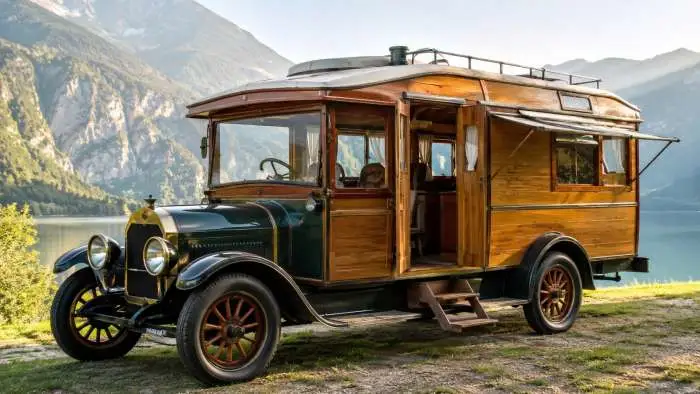
There's an old and storied history of recreational vehicles - all the way back to the horse and wagon conceived a few millennia ago! Today, RV's and campers aren't something totally new, either - the first well-built recreational caravans popped up back in the late 1800s, and motorized home came along way back in 1904. Shortly after, the world's first caravan club sprang up, and then America's earliest R.V. Camping club - the Tin Can Tourists - sprang into existence in 1919.
RV wonders of the ancient world
The Sumer people invented the first wagon in Ancient Mesopotamia as early as the fourth millennium BC, not much after they invented the wheel. Leisurely holidays came in only slightly after that – but wouldn’t truly start taking off until after 300 BC when the Romans decided to build an elaborate network of roads. Tourism remained exclusively for the very well off, who had the resources to relax by the sea at a villa or make a journey to a distant temple. The elite of Rome from the first century AD travelled in carrucas dormitoriaes (sleep coach) to sleep over the course of overnight travel. This rather splendid example with the bronze embellishment’s houses at the Romano-Germanic Museum, Cologne.
You may also read :- What Can it Mean to Truly Collaborate as a Photography Collective?
Romani and Irish Traveller vardos
For travelling long-distance, those with the luxury commonly used carriages through the Middle Ages and early Modern period; the only compromise was to sleep and eat in coaching inns. The very first travelling homes served Europe’s various traveling circuses, freak-shows, and menageries of the early 19th Century. Soon the itinerant Romani and Irish Travelling community followed, and they readily adopted en masse by the 1850s. This Romani family, with their Vardo (caravan), near a camp in London’s Notting Hill, was photographed in 1877.
Vardo RV inspiration
Colorful, richly decorated and extravagantly ornamented, Vardos typically feature traditional Celtic and Irish Traveller motifs, including flowers, vines and horse images. Inspired by the charismatic horse-drawn wagons, naval doctor and novelist William Stables commissioned the construction of the world’s first pleasure caravan in 1884, and builders completed it by the year after.
The Wanderer: inspiration for the world's first RV movement
Stables started out on his great tour of Britain in 1885 in extravagant fashion from his home in Berkshire to Inverness, accompanied by a valet, cook, coachman, Newfoundland dog, and a cockatoo. At that point the valet needed to cycle ahead of him warning approaching road users it was coming, and at times unwelcome residents threw stones at the vehicle. Stables became such an icon he led to a 'Gentleman Gypsy' craze, the world's first RV movement, in the years after he hit the road. But in actual fact the fashion attracted men and women who built luxurious touring caravans to traverse the country, with many also employing staff to sleep in tents alongside the caravans, the world's first glampers.
The Wanderer: restoration and current home
When Stables died in 1910, he left the Wanderer to his daughter Ottoline. He was to be the owner until the club’s celebrated collection received the pioneering RV, still in the Stables family, in 1961 – and the National Motor Museum proudly keeps it on display. After a decade-long refurbishment in time for the club’s 100th anniversary in 2007 – when a special event at Buckingham Palace even made the ancient caravan the centre of attention – the Broadway Caravan and Motorhome Club Site in Worcestershire houses the magnificent 19th century caravan in a former goods shed.
Ford Model T Motor Caravan (1914): the world's oldest surviving motorhome
The world's first RV – which can trace its origins back to 1904, according to Smithsonian Magazine – American made it was (though people have disputed that the vehicle is the first true RV, and someone scrapped it long ago) but the first to ever go into production was in 1910 – this one being the Pierce-Arrow Touring Landau. Unfortunately, no models have emerged today, and so we have to turn to another well-preserved and interesting vehicle to find the oldest RV in existence… This exceptional RV dates from 1914 and the family that would become the owners of Bentalls department stores built it in the UK. The body work sits on an up-specced Ford Model T Chassis, and Dunton of Reading handcrafted it, renowned as excellent quality makers of traditional vardos.
Ford Model T Motor Caravan: recent Bonhams sale
The timber motor caravan's charming interior will make you feel just as warm and cosy inside, as the 1950's structure already makes you feel externally. Seating up to four people, there's a leather sofa, the stove that will warm you from the winter chills, velvet curtains and a Welsh-style dresser, amongst brass lighting and other details from a bygone era. It comes as no surprise that, at the motor caravan's sale at Bonhams in September 2022, it sold for the highest ever price recorded, at an impressive $79,400 (£63.3k) - more than two times over the price guide.
Conclusion
While modern road trips feel like a relatively new trend, packing up your life and hitting the highway is actually a centuries-old tradition. From the "sleeping coaches" of ancient Roman elites and the beautifully crafted Romani vardos to William Stables’ eccentric Victorian tours in "The Wanderer," humans have always looked for ways to travel without leaving the comforts of home behind. Today's high-tech motorhomes might have solar panels and indoor plumbing, but they share the exact same DNA as the 1914 Ford Model T camper. Ultimately, the desire to explore the open road with your bed in tow is one of our oldest and most enduring adventures.
FAQ
Q: What is a "vardo" and how did it influence RV history?
A: A vardo is a colorful, highly decorated horse-drawn wagon used by Romani and Irish Traveller communities starting in the 1850s. Their cozy, practical designs inspired the creation of the very first leisure caravans, proving that mobile living could be both functional and comfortable.
Q: What was "The Wanderer" and why is it famous?
A: Commissioned in 1884 by William Stables, "The Wanderer" was the world’s first custom-built pleasure caravan. Stables traveled Britain in it alongside a full staff (and a pet cockatoo), sparking a "Gentleman Gypsy" craze that essentially started the modern RV and glamping movement.
Q: Where is "The Wanderer" kept today?
A: After a massive ten-year restoration, the historic caravan is now on display at the Broadway Caravan and Motorhome Club Site in Worcestershire, England.
Q: What is the oldest surviving motorhome in the world?
A: That title belongs to a 1914 Ford Model T Motor Caravan. Built in the UK on an upgraded Model T chassis, its custom wood body features a cozy interior complete with a leather sofa, a wood-burning stove, and even a Welsh-style dresser.
Q: How much is the world's oldest surviving motorhome worth?
A: In September 2022, the 1914 Ford Model T caravan was sold at a Bonhams auction for an impressive $79,400 (£63.3k)—which was more than double its original estimated price.
Q: Did ancient civilizations have their own version of RVs?
A: Yes, in a way! After the Romans built their massive road network around 300 BC, wealthy citizens began traveling for leisure. By the first century AD, the elite used carrucas dormitoriaes (sleeping coaches) so they could comfortably sleep through long, overnight journeys.