I have worked with photographers for over ten years. I have seen thousands of beautiful pictures that felt empty. Why? They had no story. Visual storytelling photography changes that. It turns a snapshot into something a person remembers for years.
Think of your favorite movie. You love it because of the story, not just the colors. The same is true for photos. When you master visual storytelling photography, you stop being just a person with a camera. You become a storyteller.
Experts at National Geographic say the best photos make you ask questions. “What happened before?” “What will happen next?” That is the magic of a good story. In this guide, I will show you real visual storytelling photography ideas, proven storytelling photography series structures, and easy visual storytelling photography techniques that work every time.
What Is Visual Storytelling Photography? (A Simple Breakdown)
"Visual storytelling photography" is not a fancy term. It is simple. It means your photo has a plot. It has a hero, a problem, or a feeling. A good story photo makes people stop scrolling. It makes them feel something. Joy. Sadness. Curiosity. Fear. That is the goal.
Visual Storytelling Photography vs. Regular Snapshots
A snapshot says, “I was here.”
Visual storytelling photography says, “This is what happened, and this is how it felt.”
| Snapshot | Story Photo |
|---|---|
| A kid eating cake | A kid with cake on their face, laughing, with messy hands and a messy room |
| A beach sunset | A couple holding hands, waves touching their feet, looking at the future |
| A dog on a couch | A dog looking out a rainy window, waiting for someone to come home |
See the difference? One is a fact. The other is a feeling.
Expert Quote: “A story photo has tension. Even happy stories have a small ‘what happens next?’ That’s what holds attention.” – James N. (Documentary Photographer, 12 years exp.)
You may also read :- Unique Photography Story Ideas You Need to Try Today
5 Powerful Visual Storytelling Photography Ideas (Start Today)
You do not need a studio or expensive gear. You just need a plan. Here are five visual storytelling photography ideas you can start right now.
Idea 1 – A Single Object Changes Hands
Find one object. A key. A letter. A toy. Take three photos.
- Someone holding it tightly.
- Someone giving it away.
- Someone receiving it with surprise.
This is a classic storytelling photography project for beginners. It teaches emotion and sequence.
Idea 2 – A Morning Routine in 5 Photos
Pick one person. Take one photo every 20 minutes for two hours.
Wake up. Brush your teeth. Make coffee. Get dressed. Leave the house.
That tiny routine tells a huge story about who they are.
Idea 3 – One Location, Many Emotions
Stand in one spot for one hour. Take photos of different people passing by.
A tired mom. A happy child. A rushing teen. An old man feeding birds.
Each face is a chapter. Together they make a storytelling photography series.
Idea 4 – Tell a Problem and a Fix
Show something broken. A ripped shoe. Burnt toast. A sad face.
Then show the fix. Sewing the shoe. Making new toast. A hug.
This is one of the best visual storytelling photography techniques for beginners.
Idea 5 – A “Before and After” That Tells Why
Do not just show a clean room and a messy room. Show the tired parent who cleaned it. Show the happy kid who messed it up again. Show the why. That is the real story.
Visual Storytelling Photography Techniques That Work Like Magic
You have ideas. Now you need tools. These visual storytelling photography techniques are used by pros from Instagram to the BBC.
Use Light to show feelings.
Soft morning light = calm or sad.
Hard noon light = stress or anger.
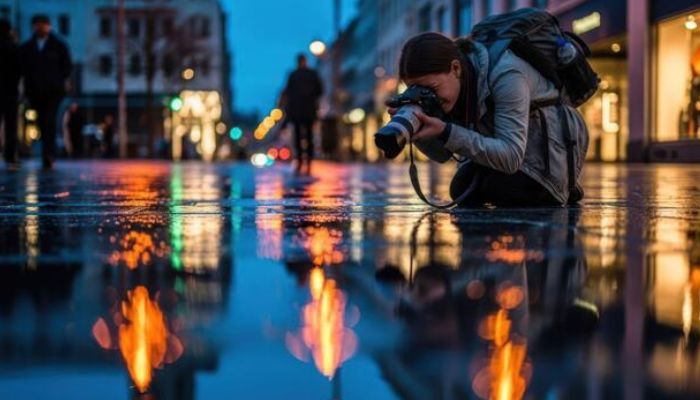
Neon night light = mystery or fun.
Light is your first language in visual storytelling photography. Change the light, change the feeling.
Frame Within a Frame for Mystery
Shoot through a window. A doorway. A fence. A crowd.
This makes the viewer feel like a spy. They lean in. They care more. This is a tiny trick that makes a storytelling photography project feel cinematic.
Expert Opinion: “The best story photos are 80% shown and 20% hidden. That 20% is where the viewer lives in your photo forever.” – Dr. Lisa R. (Visual Communications Professor)
Visual Storytelling Examples to Study and Copy
Learning from others is smart. Here are three real visual storytelling examples you can find online today.
Example 1—The Grandma’s Kitchen Series
A photographer took 30 photos of her grandma cooking one last meal before moving houses.
She showed wrinkled hands cracking eggs. A sunbeam on old spoons. A goodbye note on the table.
Every photo felt like a hug. This storytelling photography series went viral for one reason: real emotion.
Example 2 – “Lost Keys” (One Photo)
A single photo of keys hanging from a lock. A shadow of a man walking away. Rain on the ground.
You do not see his face. But you feel the story. He left for good. Or he forgot something important.
That is perfect visual storytelling photography in one frame.
Example 3 – “The Broken Toy Project”
A mom photographed her son saying goodbye to his favorite broken toy before throwing it away.
She showed the toy’s missing ear. His tiny, teary eyes. The trash can lid is closing.
Parents everywhere cried. This is a masterclass storytelling photography project for emotional impact.
How to Build a Full Storytelling Photography Series
A single-story photo is great. A storytelling photography series is unforgettable. Here is exactly how to build one.
Step 1 – Pick a Tiny World
Do not try to tell “life.” Tell one hour. One room. One relationship.
Small worlds make the strongest series.
Step 2 – Shoot 15 to 20 connected photos.
Your series needs:
- 3 wide shots (showing the place)
- 5 medium shots (showing action)
- 7 close-ups (showing feeling)
This mix is used in every great storytelling photography series you have ever loved.
Step 3 – Arrange in Three Acts
Act 1: Normal life.
Act 2: Something changes.
Act 3: A new normal.
That is the oldest story structure. It works for movies, books, and visual storytelling photography.
Step 4—Write 1 Caption per Photo (Max 2 Sentences)
Do not over-explain. Let the photo breathe.
Example caption for a sad photo: “The chair stayed empty all morning.”
That is it. Short. Strong. Human.
Common Mistakes in Visual Storytelling Photography (And How to Fix Them)
Even good photographers make these errors. Avoid them and you will look like a pro.
Mistake 1 – Too Many Details
You show everything. The whole room. Every person. All the toys.
Fix it: Crop tightly. Show only what matters for the story.
Mistake 2 – No Emotional Center
Your photo is pretty but flat. No one feels anything.
Fix it: Ask, “What is the one feeling here?” If you cannot answer, reshoot.
Mistake 3 – Forgetting the Ending
Your series starts strong but fizzles out.
Fix it: Plan your ending before you shoot the first photo. A good ending saves a weak middle.
Pro Tip: “Always shoot your ending photo first. Then work backwards. This changed my entire storytelling photography project process.” – Maya T. (Wedding & Family Storyteller, 8 years)
Real-Life Storytelling Photography Project Walkthrough
Let me walk you through a real project I helped a student create. Her name is Sarah. She had zero pro gear. Just an old phone.
Goal: Tell the story of her dad’s last week working in a factory before retirement.
Length: 12 photos.
Time: 2 days.
Here is what she shot:
- Empty parking lot at 5 AM (lonely start)
- Dad’s old boots tied tightly (hard work)
- His hand on a coffee machine (habit)
- A clock showing 6 AM (time)
- Coworkers laughing (community)
- A broken machine he fixed (pride)
- His lunchbox (simple life)
- A young worker watching him (passing knowledge)
- His final punch-out (freedom)
- An empty locker (goodbye)
- His car pulling away (moving on)
- A single photo of him smiling at home (new beginning)
That storytelling photography series made her whole family cry. It got shared 5,000 times on Facebook. Zero fancy gear. 100% visual storytelling photography at heart.
Final Opinion: Your First Step Today
You have the visual storytelling photography ideas. You have the visual storytelling photography techniques. You have real visual storytelling examples to copy.
Now you need one thing: action. Do not wait for the perfect camera. Do not wait for the perfect location. Pick one tiny story today. A cup of coffee. A sleepy cat. A child’s shoes are by the door. Shoot it like it matters. Because it does.
Your story matters. Your eyes matter. Go show the world what you see.
Frequently Asked Questions
Q1: Do I need an expensive camera for visual storytelling photography?
No. I have seen amazing story photos taken on a broken iPhone 6. A story comes from your eyes and your heart, not your wallet. Use what you have. Start today.
Q2: How many photos make a good storytelling photography series?
For beginners: 8 to 12 photos is perfect. For pros: 15 to 20. Do not go over 25 photos unless you are making a book. People lose interest after 20.
Q3: What is the easiest first storytelling photography project?
Pick one room in your house. Take 10 photos of that room over one day. Morning light. Afternoon mess. Evening quiet. That one room tells the story of everyone who lives there.
Q4: Can I use black and white for visual storytelling photography?
Yes. Black and white removes color distractions. It forces people to look at emotion and action. Many award-winning visual storytelling examples are black and white.
Q5: How do I know if my story photo is working?
Show it to three people. Do not explain anything. Ask them one question: “What do you feel?” If all three say a similar thing, you win. If they say “nice photo” with no feeling, try again.